By Amy Boyle
Antoni Gaudí was a Catalan architect and a leading figure in the Catalan Modernisme movement. The buildings he designed have left an indelible mark on the city of Barcelona and across Catalonia. In December 2025, I took a trip to Barcelona to explore the genius of Gaudí for myself and it did not disappoint.
Sagrada Família
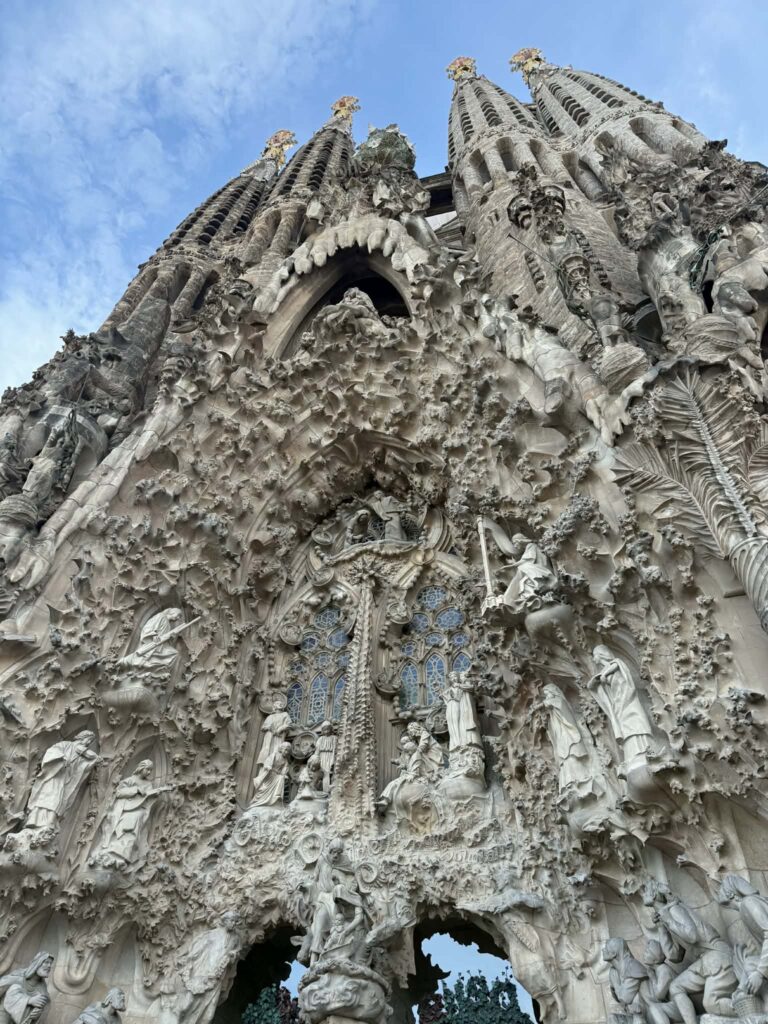
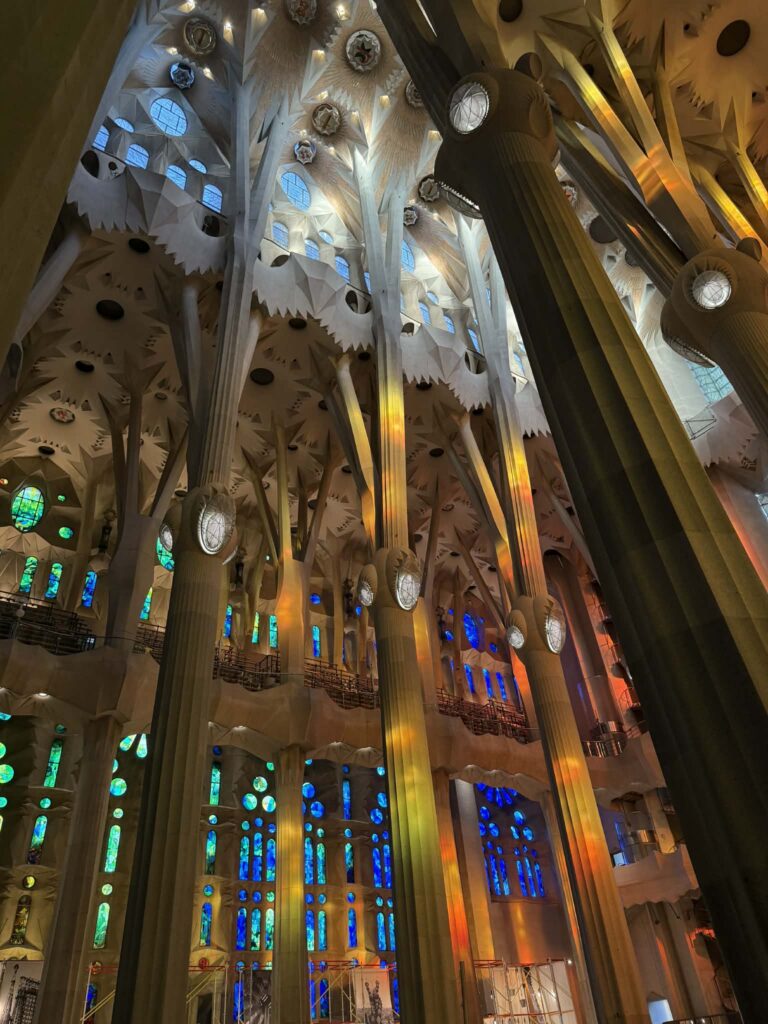
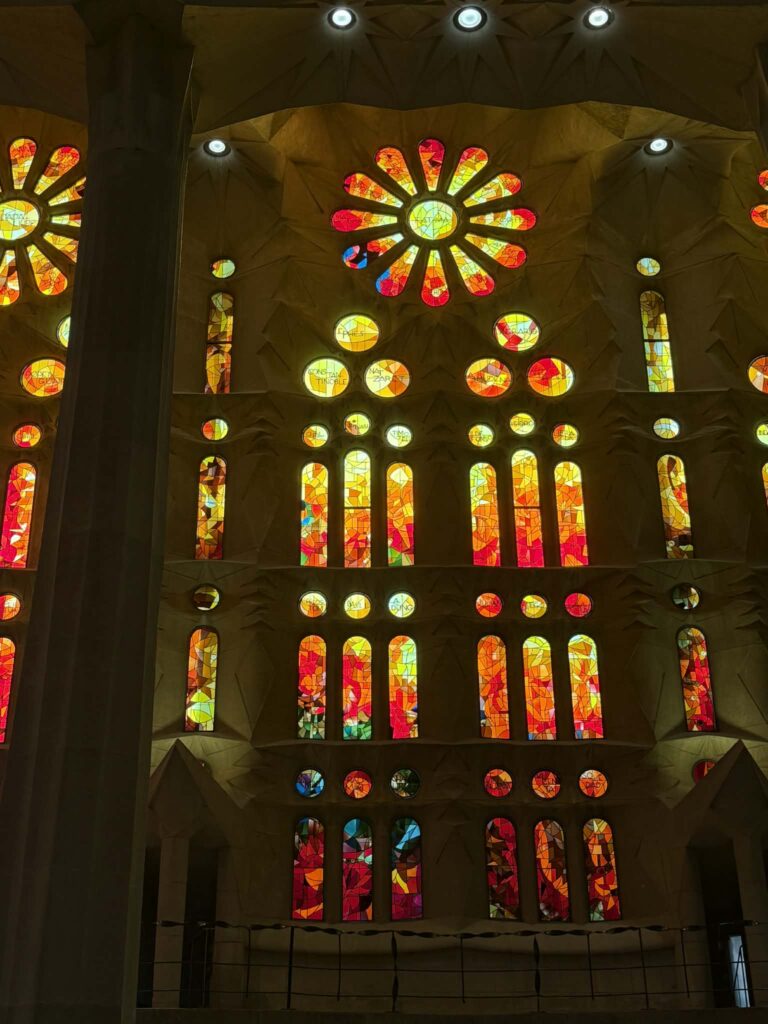
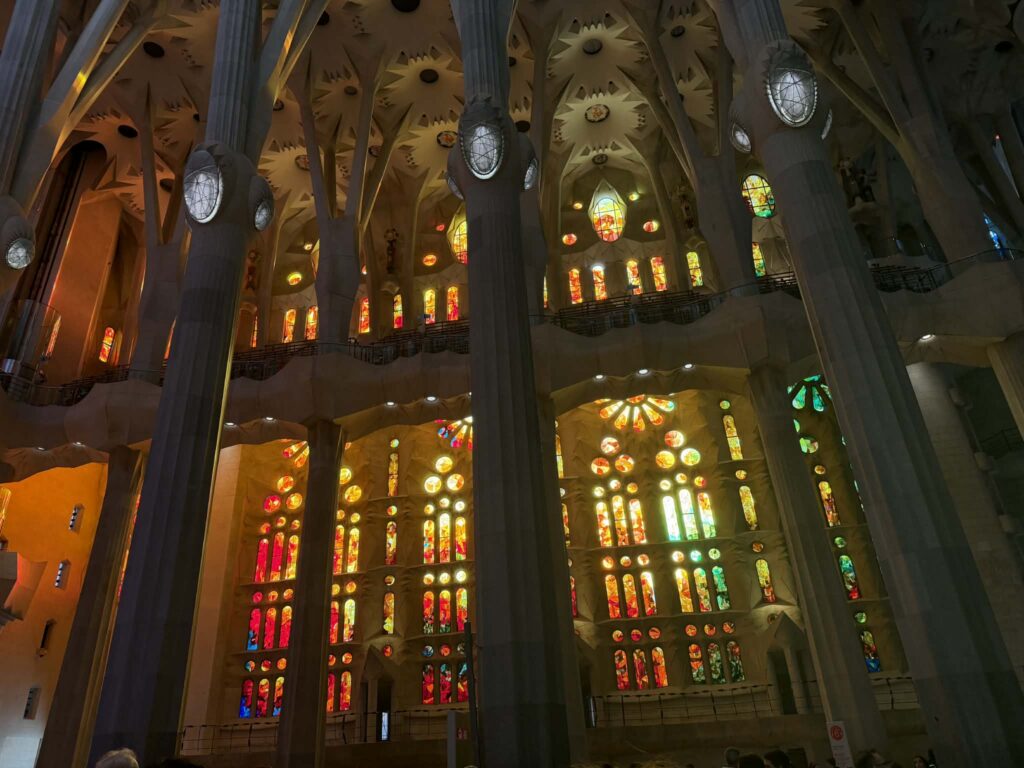
In the heart of Barcelona you will find the Sagrada Família. The striking facades and awe-inspiring interior of this famous basilica are best understood in person. Although still under construction, the Sagrada Família is one of the most architecturally interesting buildings I have ever encountered. Everywhere you look, the genius of Gaudí’s geometrical innovation can be seen – from the central pillars that mimic trees as well as providing structural support, to the careful composition of the basilica’s outer facades. In the design of the basilica, Gaudí works with shapes and space in the most unique way, ensuring light in all areas of the internal basilica without compromising on structure or stability.
In 1936, during the Spanish Civil War, anarchists destroyed most of Gaudí’s original designs. As a result, his disciples and other artists have worked tirelessly to re-create the designs in Gaudí’s style, the results of which can be seen in the newest façade known as the ‘Glory Façade’ – a testament to the influence and ever-lasting nature of Gaudi’s genius.
Casa Batlló
The Casa Batlló is another of Gaudí’s famous works. Viewing it from the street, the curved and colourful windows are striking, but it takes venturing inside to truly understand and appreciate the careful architectural and geometric innovations that have made this one of Barcelona’s most visited and well-known buildings.
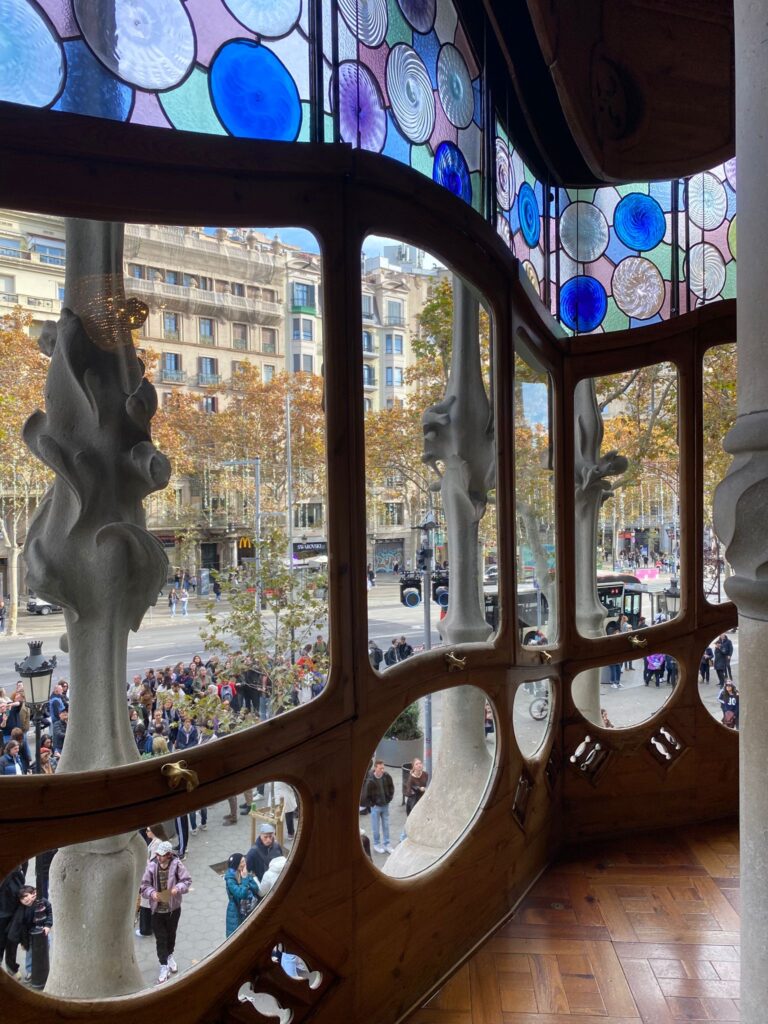
Gaudí was heavily inspired by the natural world, and the interior of Cassa Batlló is designed to transport you under the sea, with wavy surfaces, textured and stained glass, and shades of green and blue used to reflect this. Gaudí works effortlessly with shapes, surfaces and space to create an interior that is both calming and full of life. The main floor with the well-known wave-like windows is perhaps the most striking, with an undulating ceiling in the main living room of the house which further alludes to the sea. The Lightwell is also particularly notable, used to distribute light evenly throughout the house – bringing the natural world inside.
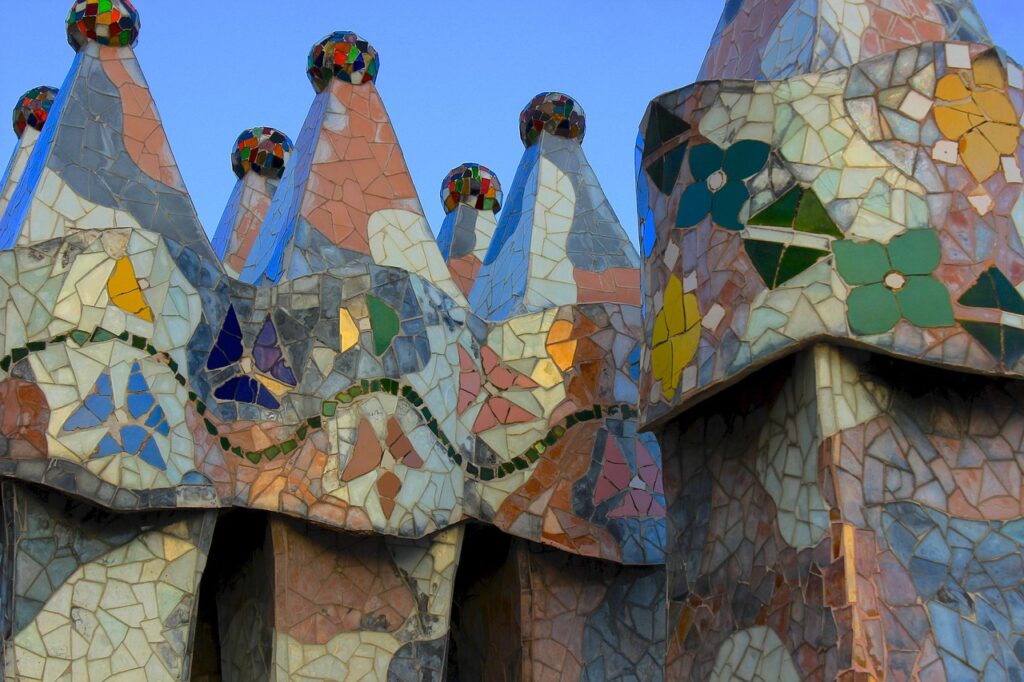
I was particularly interested by the Trencadis technique which can be seen in the garden of Casa Batlló and on the outer façade, used both as part of the architecture and as decoration. Here, Gaudí uses geometry to create fluid patters inspired by nature, such as waves and leaves, but within structured architectural elements. In this way, the architecture and geometry work with and against each other. It is something truly inspiring to see.
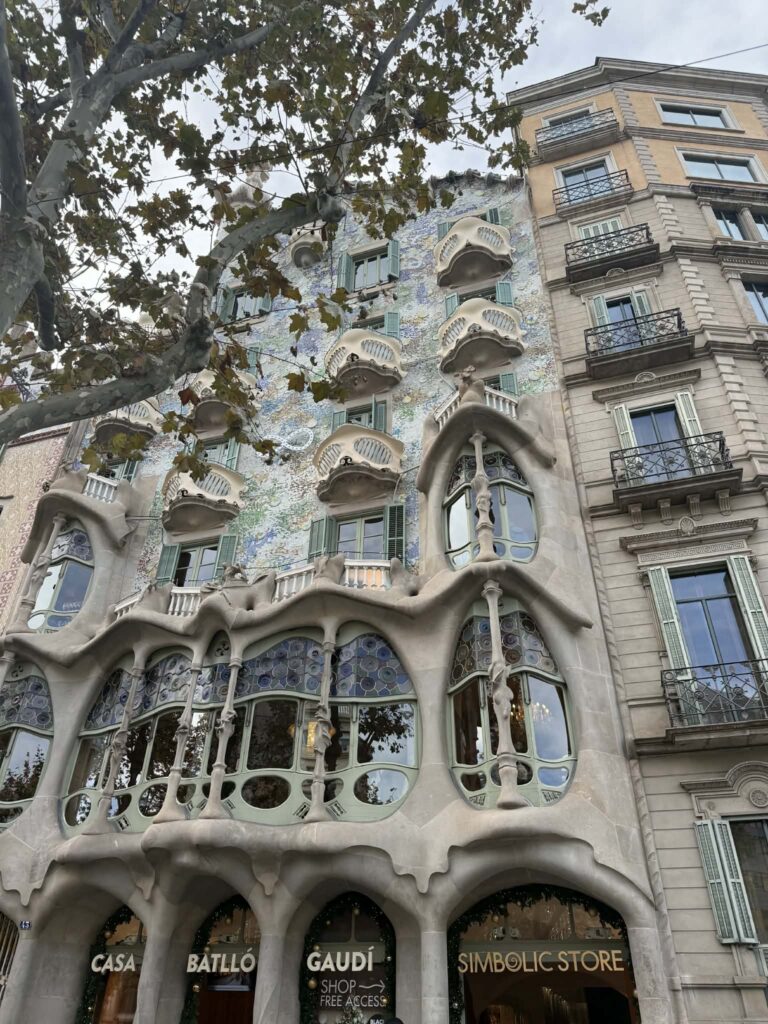
The outer façade of Case Batlló blends architecture with history and legend. Crowned with a scale-like roof reminiscent of a dragon, many believe the outer façade to be a reference to the legend of Saint George, the patron saint of Catalonia, with the bone like structures on the balconies and columns and the tower with a four-armed cross recalling the tale of Saint George who killed the dragon to save the princess (Casa Batlló). Geometry is used creatively here, utilising shapes and surfaces to tell two stories at once – the story of an aquatic landscape and the story of Saint George, allowing the viewer to perceive and interpret the structure in multiple ways.
La Pedrera
The building known in Barcelona as La Pedrera (formally known as Casa Milà) had a profound impact on the fields of spatial geometry and construction (La Pedrera).
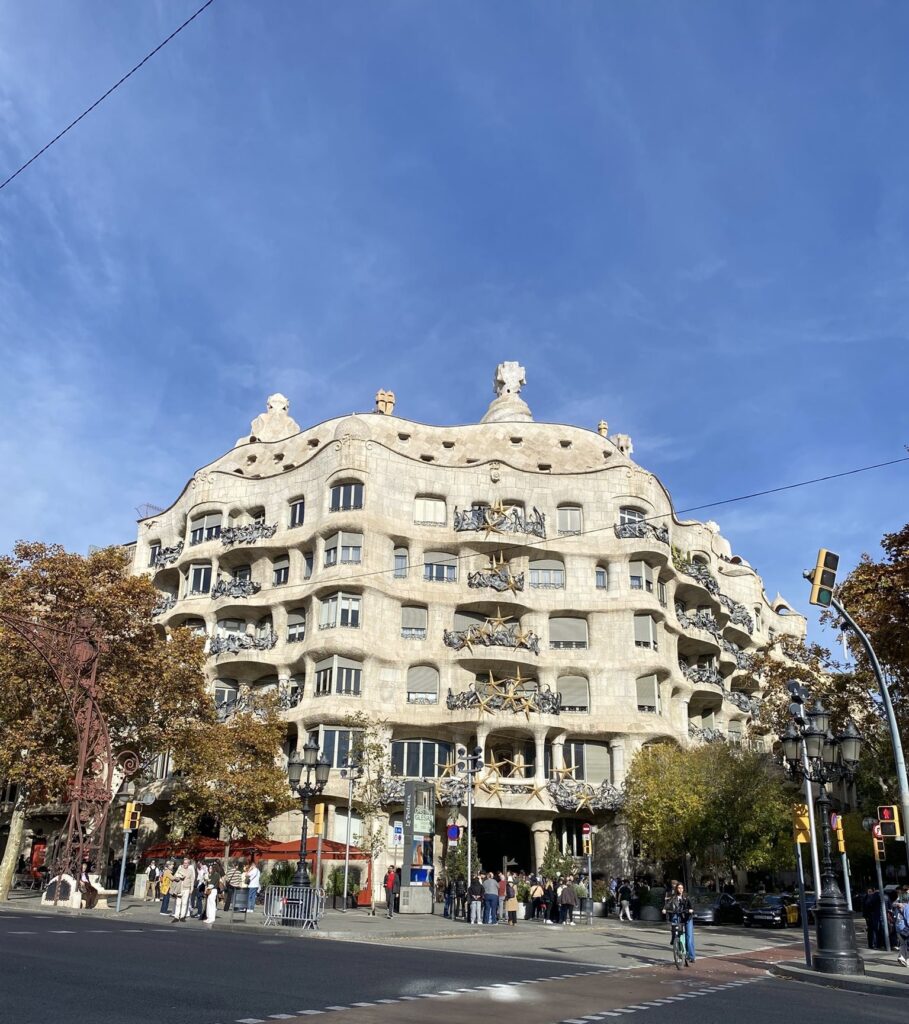
Gaudí was a modern architect ahead of his time and the buildings that are relished today were not always perceived this way. La Pedrera loosely translates to the ‘stone quarry’. When enquiring about this with a Barcelona local, I was informed that, at the time La Pedrera was built, many people living in Barcelona did not like it and believed that the unconventional stone façade and rocky appearance was reminiscent of a quarry. In fact, when I asked what La Pedrera translated to, they translated this as ‘pile of rocks’ which points to the controversy surrounding the building when it was first constructed due to the its resistance to early 20th Century stylistic conventions.
The contrast of La Pedrera to Casa Batlló is stark, with the colourless stone and metal elements directly contrasting the vibrancy of the Casa Batlló outer façade. However, elements of Gaudí’s personal style and use of shapes can still be seen in the wave-like stone façade of La Pedrera which calls once again to the natural world. Gaudí’s unique blend of organic forms and intricate textures speak to his architectural genius. His personal style is so unique that a visitor to Barcelona with no prior knowledge of Gaudí or his work would be able to connect the buildings he designed by merely a glance.
Gaudí’s Influence
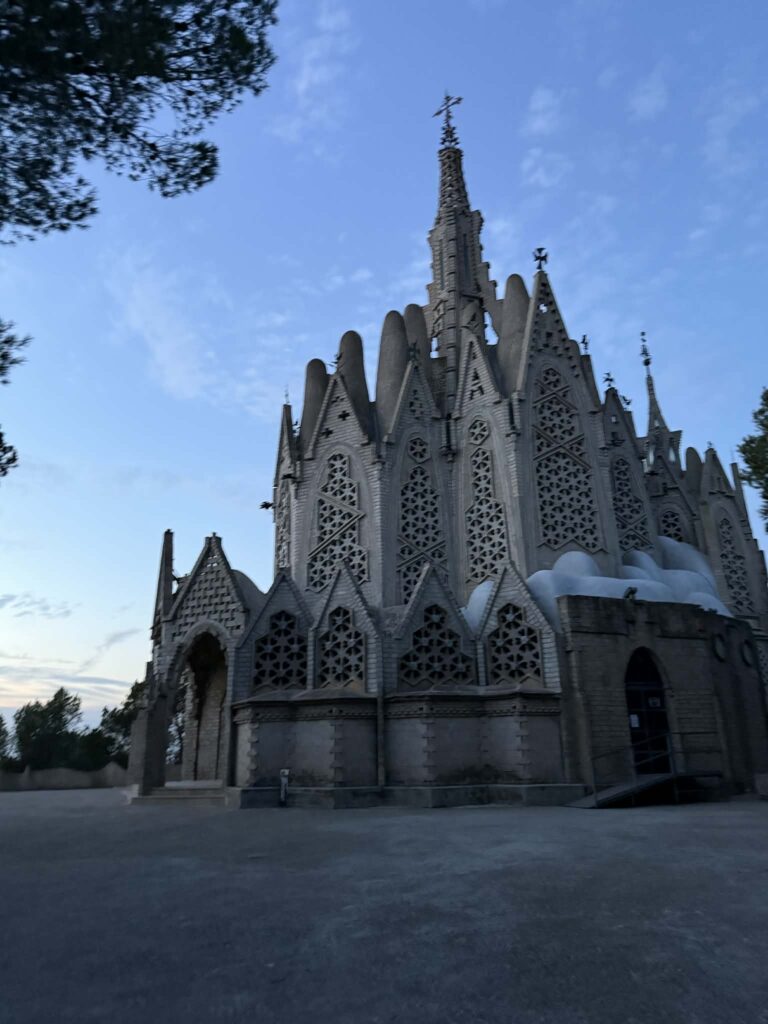
Later this year, I will be attending a wedding in Catalonia. The ceremony will be held at Santuari de la Mare de Déu de Montserrat. Considered a ‘masterpiece of Catalan modernism’ (Atlas Obscura), this beautiful temple was built by one of Gaudí’s disciples, Josep Maria Jujol. The influence of Gaudí’s genius can be seen in the striking facades and the natural world influences such as the exterior vaults which showcase imitations of the Montserrat mountains rock formations. In fact, many refer to it as a mini Sagrada Família. June 10th 2026 marks 100 years since Gaudí’s death. It is inspiring to see that the genius of Gaudí lives on in the buildings that he designed in the heart of Barcelona, and in the buildings that continue to be built around Catalonia and Spain that retain his influence – geometrical and architectural masterpieces.
Find out more about Gaudí’s constructions in The Genius of Gaudí from the American Mathematical Society.